18 Rare Dogs That Time (Almost) Forgot
Dogs have been our loyal companions for thousands of years, but not all breeds enjoy the popularity of Labradors or German Shepherds. Hidden in the corners of the canine world are remarkable breeds with fascinating histories and unique traits that few people know about.
These rare dogs have nearly disappeared from our collective memory, yet they possess qualities that make them truly special. Let’s explore these forgotten canine treasures that deserve more recognition.
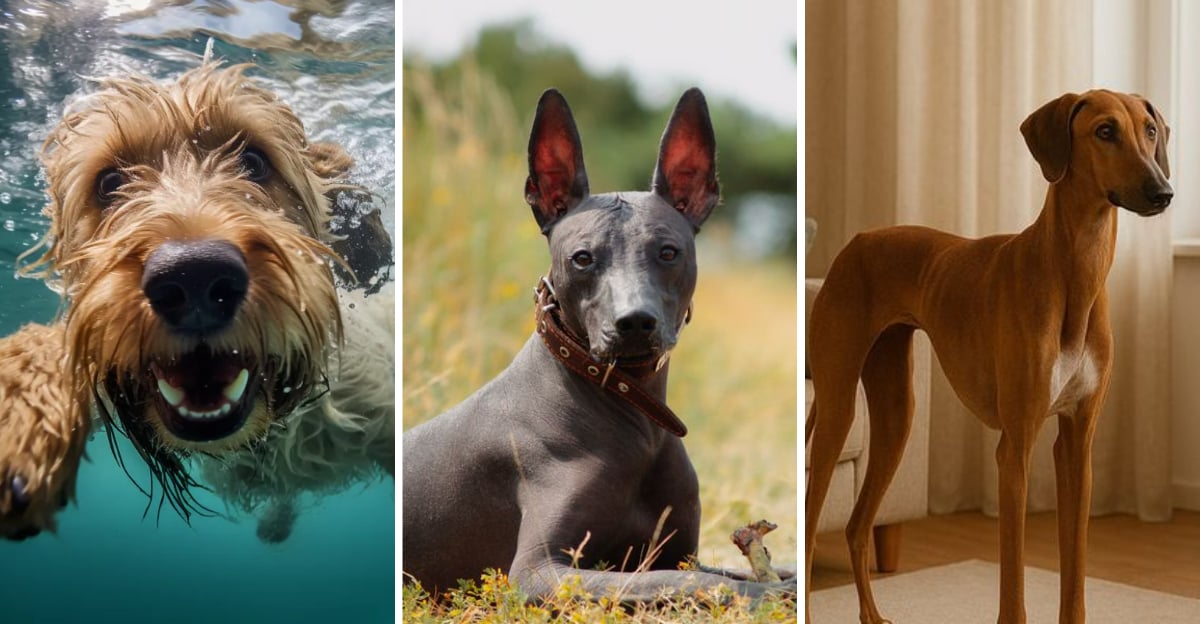
1. Otterhound: The Waterlogged Wonder
With webbed feet and a rough, waterproof double coat, Otterhounds were once prized for hunting otters in British rivers. Today, fewer than 800 exist worldwide, making them rarer than giant pandas!
These shaggy swimmers possess an extraordinary sense of smell, second only to Bloodhounds. Their boisterous personality and deep, melodious voice make them unforgettable companions, though their enthusiasm can sometimes overwhelm unprepared owners.
Originally developed in medieval England, these gentle giants nearly vanished when otter hunting was banned in 1978. Despite their hunting heritage, they’re affectionate family dogs who simply need plenty of exercise and occasional swimming opportunities.
2. Azawakh: Desert Sprinter
Elegance personified, the Azawakh hails from West Africa’s Sahel region where nomadic tribes treasured them as hunting companions and guardians. Their incredibly lean build showcases prominent hipbones and ribs—perfectly normal for this breed but often mistaken for malnourishment by the uninformed.
Fiercely loyal to their families yet aloof with strangers, these dogs form deep bonds with their chosen people. Their speed is legendary—reaching up to 40 mph in short bursts across desert terrain. Unlike many breeds developed by deliberate human selection, the Azawakh evolved naturally in its harsh environment.
Their regal bearing and independent nature reflect centuries of partnership with the Tuareg, Fula, and other nomadic peoples.
3. Dandie Dinmont Terrier: Literary Legend
Sporting a distinctive “topknot” of silky white hair and an elongated body, the Dandie Dinmont is the only dog breed named after a fictional character! Sir Walter Scott’s novel “Guy Mannering” featured a farmer with these distinctive terriers, launching them into brief fame.
Despite their small stature—standing just 8-11 inches tall—these dogs pack tremendous personality into a compact package. Their determined nature makes them excellent vermin hunters, while their dignified demeanor earned them favor among both nobility and working folk in the Border country between Scotland and England.
With fewer than 300 puppies registered worldwide annually, this 200-year-old breed faces extinction without dedicated preservation efforts.
4. Norwegian Lundehund: Six-Toed Puffin Hunter
Anatomical marvels, Lundehunds possess six toes on each foot, ears that fold shut, and shoulders flexible enough to reach sideways and backward! These extraordinary adaptations evolved for one specialized purpose: scaling narrow cliffs to hunt puffins on remote Norwegian islands.
When puffin hunting was banned and mainland dogs introduced to the islands, the Lundehund nearly disappeared. By 1960, only six remained alive. Through careful breeding, their numbers have increased, though they remain extremely rare. Health challenges plague the breed due to their limited genetic pool.
Many suffer from Lundehund Syndrome, a digestive disorder requiring specialized diets. Despite these challenges, their friendly, alert temperament and fascinating physical traits make them treasured companions for dedicated owners.
5. Lagotto Romagnolo: Truffle Treasure Hunter
Covered in dense, curly hair resembling a well-worn teddy bear, the Lagotto Romagnolo might look like a designer doodle, but this ancient Italian breed has been hunting truffles for centuries.
Their incredible scenting ability can detect the precious fungi growing several feet underground, making them invaluable to truffle hunters. Originally water retrievers in the marshlands of Romagna, these versatile dogs adapted when their wetlands were drained for agriculture.
Their waterproof coat and keen intelligence helped them transition to their new career as truffle hunters. Affectionate and highly trainable, Lagottos form strong bonds with their families. Their hypoallergenic coat requires regular maintenance to prevent matting, but many owners find the curly mop of hair part of their undeniable charm.
6. Thai Ridgeback: Ancient Guardian With a Mohawk
Sporting a distinctive ridge of backward-growing hair along their spine, Thai Ridgebacks remained isolated on the island of Phuket for centuries, preserving their primitive characteristics. Ancient artifacts dating back 3,000 years depict dogs with similar ridges, suggesting this breed’s remarkable antiquity.
Naturally protective and territorial, these dogs served as guardians, vermin controllers, and pulling carts in their native Thailand. Their independence stems from minimal human intervention in their breeding throughout history—they essentially evolved on their own!
With sharp intelligence and athletic ability, Thai Ridgebacks excel at problem-solving but can challenge inexperienced owners. The breed exists in four colors: red, black, blue (gray), and yellow (fawn), with the blue being particularly uncommon even within this rare breed.
7. English Foxhound: Pack Hunter Extraordinaire
Despite being the foundation for America’s most popular hound, the English Foxhound remains surprisingly scarce as a companion animal. Created specifically for pack hunting in the English countryside, these athletic dogs possess incredible stamina and can run for hours without tiring.
Their melodious bay—a distinctive voice used to alert hunters to prey—echoes their hunting heritage. Unlike many rare breeds, their scarcity isn’t due to dwindling numbers but rather their specialized purpose; most live in hunting packs rather than family homes.
Good-natured and sociable with both humans and other dogs, English Foxhounds nonetheless require substantial exercise and space. Their strong pack mentality makes them happiest with canine companions, and their hunting instincts need appropriate outlets to prevent behavioral issues.
8. Xoloitzcuintli: Ancient Hairless Healer
Sacred to the Aztecs and dating back over 3,000 years, the Xoloitzcuintli (pronounced “show-low-eetz-QUEENT-lee”) was believed to guide souls to the underworld.
These dogs come in three sizes and two varieties—hairless and coated—with the hairless sporting smooth, warm skin in various colors. Aztec healers used them as living hot water bottles, believing their warm bodies could draw out pain and illness.
Modern owners still appreciate their soothing warmth against sore muscles or arthritis. Highly intelligent and surprisingly athletic, Xolos form intense bonds with their families while maintaining a dignified reserve.
Their primitive nature means they’re less prone to genetic health issues than many modern breeds, though their hairless skin requires protection from sun and cold.
9. Pyrenean Mastiff: Gentle Giant of the Mountains
Towering guardians of Spanish flocks, Pyrenean Mastiffs can weigh over 200 pounds yet move with surprising grace. Their massive white coats, often marked with gray or tan patches, helped shepherds identify them at night when wolves might attack their sheep.
Unlike many livestock guardians, these giants developed a particularly calm, measured temperament. Rather than chasing predators, they typically positioned themselves between the threat and their flock, using their imposing presence as deterrence before resorting to physical confrontation.
Nearly extinct after Spain’s Civil War depleted their numbers, dedicated breeders saved them from disappearing entirely. Today they remain rare outside their homeland, with their enormous size and specific guarding instincts making them suitable only for experienced owners with appropriate space.
10. Telomian: Malaysia’s Village Climber
Perhaps the rarest breed on our list, Telomians developed naturally in the Malaysian jungle where indigenous peoples valued their rat-catching abilities. Their most remarkable feature? Specially adapted paws that allow them to climb ladders to reach elevated village huts built to avoid flooding and predators.
Only a handful exist outside Malaysia, following their 1963 discovery by anthropologist Dr. Orville Elliot. Medium-sized with short coats usually featuring tan or reddish markings, Telomians retain many primitive characteristics including exceptional climbing ability and independent problem-solving.
Not recognized by major kennel clubs and with extremely limited breeding programs, these dogs remain largely unknown even to dog enthusiasts. Their natural development in isolation created a uniquely adapted canine unlike any deliberately bred dog.
11. Cirneco dell’Etna: Sicily’s Ancient Hunter
Often mistaken for a small Pharaoh Hound, the Cirneco dell’Etna (pronounced “cheer-NAY-ko”) has hunted rabbits on Mount Etna’s volcanic slopes for over 2,500 years.
Ancient coins from 500 BCE depict dogs remarkably similar to today’s breed, showcasing their remarkable consistency throughout millennia. Their large, erect ears serve dual purposes—capturing sound and releasing body heat in Sicily’s intense Mediterranean climate.
Incredibly efficient hunters, they work primarily by sight, scent, and sound, requiring minimal direction from humans. Gentle at home but tenacious in the field, these elegant sighthounds nearly disappeared in the early 20th century before dedicated preservation efforts saved them.
Their moderate size, clean lines, and low-maintenance short coat belie their ancient heritage and surprising rarity outside their native Italy.
12. Stabyhoun: Dutch All-Purpose Farm Dog
Named from the Dutch words for “stand by me,” the Stabyhoun embodies versatility in a medium-sized package. Farmers in Friesland, Netherlands, developed these black, brown, or orange-and-white dogs to hunt, retrieve, control vermin, pull small carts, and guard property—all while being gentle family companions.
Despite their multitude of talents, fewer than 7,000 exist worldwide, with strict breeding controls in their homeland to maintain health and temperament. Unlike many rare breeds, Stabyhouns aren’t disappearing due to lack of functionality but rather because of their geographic isolation.
Remarkably balanced in temperament, these dogs combine working drive with household manners. They’re particularly noted for their “soft mouth”—the ability to retrieve game without damaging it—and their striking spotted coats that require minimal grooming despite their medium length.
13. Carolina Dog: America’s Wild Canine
Not created by human breeding programs, Carolina Dogs emerged naturally in the isolated swamps and forests of the American Southeast. Their distinctive appearance—prick ears, fishhook tail, and dingo-like build—remained consistent for generations because they lived largely independent of humans until the mid-20th century.
DNA studies suggest these “American Dingoes” may descend from the earliest dogs to cross the Bering land bridge with ancient Asian migrants. Dr. I. Lehr Brisbin discovered them living wild in the 1970s and recognized their unique characteristics and behaviors, including ritualized pack hunting and distinctive digging patterns.
Newly domesticated specimens adapt surprisingly well to family life while retaining primitive traits like seasonal breeding and natural wariness. Their numbers remain limited despite growing interest in these living links to prehistoric canine-human partnerships.
14. Mudi: Hungary’s Versatile Herder
Sporting a distinctive wavy-to-curly coat in unusual colors like smoke, merle, and white-marked black, the Mudi (pronounced “moody”) performs nearly any task asked of it. Hungarian shepherds relied on these medium-sized dogs to herd cattle, sheep, and even stubborn pigs through challenging terrain.
Natural disasters and world wars nearly obliterated the breed before a dedicated rescue effort began in the 1960s. Today, fewer than a few thousand exist worldwide, with most remaining in their native Hungary performing their traditional work.
Boundless energy and razor-sharp intelligence make Mudis excel at modern dog sports like agility, obedience, and herding trials. They’re known for their unique “flying trot” gait and remarkable ability to work independently, making split-second decisions when herding without human direction.
15. Skye Terrier: Victorian Favorite Turned Rarity
Once the darling of Queen Victoria’s court, Skye Terriers have fallen so far from popularity that they’re now among the world’s most endangered breeds. Their most striking feature—a glamorous floor-length coat—disguises a tough working terrier body beneath the elegant exterior.
Named for Scotland’s Isle of Skye where they hunted badgers and foxes from the rocky terrain, these long, low dogs possess surprising strength in their short legs. Their distinctive appearance includes a dramatic curtain of hair that completely covers their eyes yet doesn’t impair their vision.
Famous for their unwavering loyalty, a Skye Terrier named Greyfriars Bobby guarded his deceased owner’s grave for 14 years until his own death—a dedication commemorated by a statue in Edinburgh. Fewer than 30 puppies are registered annually in their native UK, placing them on the verge of extinction.
16. New Guinea Singing Dog: Wild Canine Chorus
Neither fully wild nor completely domesticated, New Guinea Singing Dogs earned their name from their extraordinary vocalizations—harmonious howls that rise and fall in pitch like eerie, beautiful songs.
Until recently, many believed them extinct in the wild, surviving only in conservation programs and private collections. Their physical agility defies belief—they can rotate their heads 180 degrees, climb trees, and make vertical leaps of 8 feet or more.
Genetically distinct from both wolves and domestic dogs, they represent one of the most primitive canine forms still existing. Recent expeditions discovered small populations still living in remote New Guinea highlands at elevations above 10,000 feet.
With fewer than 300 in captivity worldwide and an unknown number remaining in the wild, these golden-red dogs with fox-like appearances remain one of the rarest canines on earth.
17. Karelian Bear Dog: Fearless Arctic Hunter
Bred to hunt aggressive game including bears, wolves, and moose in the frigid forests between Finland and Russia, Karelian Bear Dogs fear nothing despite their medium size. Their striking black-and-white coats provide camouflage in snowy forests while hunting, and they work silently until they’ve located their quarry.
Modern wildlife agencies employ these fearless dogs in bear aversion programs, teaching problematic bears to avoid human settlements rather than euthanizing them. Their distinctive hunting style involves holding bears at bay through strategic barking while staying just out of reach, giving human hunters time to arrive.
Fiercely independent yet devoted to their families, these dogs require experienced handling and substantial exercise. Their natural protective instincts and territorial nature make them excellent watchdogs but challenging pets for typical suburban environments.
18. Sloughi: Desert Racing Machine
Aristocrats of the dog world, Sloughis (pronounced “SLOO-ghee”) served as prized hunting companions for North African nobility for thousands of years. Their sleek bodies and long, fine-boned legs enable them to chase gazelles across vast desert expanses at speeds approaching 40 mph.
Unlike their cousin the Saluki, Sloughis possess a more reserved, almost melancholic temperament. Bedouin tribes treated them as family members rather than mere hunting tools, even allowing them inside their tents—an honor rarely granted to animals in their culture.
Political instability in their native regions of Morocco, Algeria, Tunisia, and Libya threatened their existence during the 20th century. Strict breeding programs maintain their ancient lineage, focusing on preserving both their distinctive appearance—smooth short coats in shades from light sand to mahogany—and their natural hunting abilities.